Thursday, May 31, 2007

Conservative Play Calling

It was a complaint you heard a lot last season, "The play calling is too conservative". It started as a whisper after the game against Rice, it became a loud conversation after the loss to Washington, and it was being shouted from the roof tops after the Bruins lost 4 in a row. It wasn't a pretty situation and Coach Sovboda was eventually fired because of it.

It is easy and common for fans to get upset and blame the coaches, and the play calling, when things go wrong. You hear fans from all schools do it and they do it more often as the losses pile up. Now that I have detailed statistics about the football teams in the PAC-10, I wanted to see if I could confirm or deny the belief that our play calling last year was too conservative. I think the answer will be enlightening.

In the Red Zone

In order to narrow down this topic, I decided to focus on red zone play calling. It seemed like the Bruins moved the ball pretty well last year between the 20's, but when they got into the red zone things would stall. We ended up kicking a lot of field goals, which I'm sure made Justin Medlock pretty happy, but it didn't sit well with the fans.

I ran my queries for all 10 teams in the conference. I figured that way I could get a pretty good comparison between UCLA and other schools. In particular, I wanted to see how the Bruins stacked up against the best offenses in the conference (USC, California, and Oregon) and the worst offenses (Stanford and Arizona).

How we define "conservative" is an important piece to this analysis. It is kind of subjective as each fan will have their own opinion of what the team should be doing. I figured I would go with a fairly simple definition. As the field shortens, it becomes more difficult to pass the ball, so I would say the conservative coach would run the ball more in the red zone than pass. I would also say going for it on 4th down is not something a conservative coach would attempt. Using those measurements as my standard, I crunched the numbers.

UCLA ran the ball 82 times in the red zone and passed it only 42 times. When you compare that to USC, it seems pretty conservative. The Trojans actually passed more in the red zone, 75 times to only 60 rushing attempts. At first I thought that was a pretty glaring difference, but if you look at other top offenses in the conference, like California, they had a similar ratio of passes to runs (2 runs for every 1 pass). Oregon falls in the middle between the pass happy Trojans and the run heavy Bruins and Bears. These numbers don't really give us a clear answer either way but it definitely doesn't point to UCLA being very aggressive in the red zone.

To further confirm that point, the Bruins converted 11 field goals (which ranks them first in the conference) when facing 4th down in the red zone. We only went for it once on 4th down. The Trojans, Bears, and Ducks did attempt to covert more 4th downs, but not many more. The Trojans were ultra aggressive with 5 attempts. Again, a clear answer doesn't seem to emerge from these numbers either.

Goal to Go

Since the red zone numbers were inconclusive, I narrowed the focus down even more, to just look at goal-line situations. I only looked at plays where the team faced 1st and goal-to-go and then analyzed the results. It was here that the numbers were very telling.

Again, determining what is considered "conservative" is a bit subjective. Here I decided that following the play calling pattern of run-run-pass would be a pretty conservative one. I looked at each down independently to see what was being executed.

In 1st and goal the Bruins ran the ball 17 times and only passed once. I was startled to see such a disparity in the numbers. No other team ran the ball more on first down. To make matters worse, the Bruins only averaged 1.3 yards per attempt; the only teams to average less yards per running attempt on 1st down were Stanford and Arizona. Despite the lack of results, the coaches continued to run the ball almost exclusively on 1st and goal.

On second down, things weren't that much better. The Bruins ran the ball 9 times and passed 6 times. We actually averaged less than one yard per running attempt on 2nd down, which ranked the Bruins 9th on the list. Sadly, the Bruins average 3.9 yards per passing attempt which put us 2nd. Instead of passing on second down, we were running, and getting nowhere.

Third downs were the exact opposite. We ran 4 times and passed 6 times. We averaged only 1.3 yards per pass attempt, again ranking us 9th on the list. On the four rushing attempts, we averaged 2 yards, which ranked us 2nd behind Oregon. Here we passed to little success when we could have been rushing for more yards.

It looks like the offense followed the run-run-pass pattern pretty consistently. When we followed that pattern, we gained very few yards. When we broke the pattern, we were one of the more successful teams in the conference. Unfortunately, last season we followed that conservative pattern far too often. So it should come as no surprise that the Bruins had the 3rd lowest TD percentage of all PAC-10 teams in goal-to-go situations.

When you compare these numbers to the more successful offenses in the conference, you'll see that they had a much more balanced attack in goal line situations. The Trojans ran a perfectly balanced 16 running plays and 16 passing plays in 1st and goal to go. California and Oregon ran the ball more on 1st down then USC but not with the same disparity as the Bruins.

There aren't a whole lot of plays in goal line situations, so the impact probably wasn't huge to the overall results of the team. However, the Bruins didn't capitalize on some golden opportunities to score touchdowns and the play calling was a big part of that.

You know what you know

Just to be perfectly fair, these numbers are only based on what plays were actually executed. In the modern college football offense, most plays come into the huddle with options to run or passs. The quarterback can also check-out of the called play and pick something new based on the defense he sees. We can never know exactly what was called on each play, but it seems reasonable to believe that the play executed was the same thing that came into the huddle the vast majority of the time.

Also, in the spirit of openness and honesty, this analysis is a bit superficial. It doesn't take into account the defensive formation or the specific game situation for each play. It could be possible, though highly unlikely, that running the ball 95% of the time on 1st and goal was the right decision based on what the defensive presented. Since I don't have that information, I can not be 100% certain.

That being said, I feel pretty confident in the analysis because other teams, like USC, used a markedly different mix of plays in similar situations and they played an almost identical schedule to UCLA. Personnel plays a role, and I'm sure that effected the offense strategy. But blaming the lack of scoring on the players doesn't explain why the Bruins were more successful when they diverted away from the conservative play calling mix.

Dorrell vs Svoboda

I'm sure the guys over at Bruins Nation and Dump Dorrell will be interested to know that when you perform this same analysis for the games where Dorrell had input (i.e. after the WSU game) and when just Svoboda was in charge (i.e. WSU and earlier) there is virtually no difference in the plays called. In fact, Dorrell was even more conservative, passing the ball only 26% of the time in the red zone to Svoboda's 39%. In goal line situations the team followed the run-run-pass pattern almost exclusively when Dorrell was helping call the shots.

What's interesting, and a bit counter intuitive, is that the offense actually did better after the WSU game (341 yards/gm) than before (321 yards/gm) even with tougher opponents. I think we can attribute that to Pat Cowan getting more comfortable and experienced in the offense and not the shift in offensive play calling.

Summary

So, summing all of these rambling up, it does look like the numbers confirm the feelings that many Bruin fans had last season. The play calling was fairly conservative in red zone situations and it became even more conservative (and often times very predictable) in goal-to-go situations. Hopefully new offensive coordinator Jay Norvell can change things up this year and give this offense a better chance at getting into the end zone.

(photo credit: scout.com)
(photo credit: AP)

Wednesday, May 30, 2007

How do you know it is the off season?

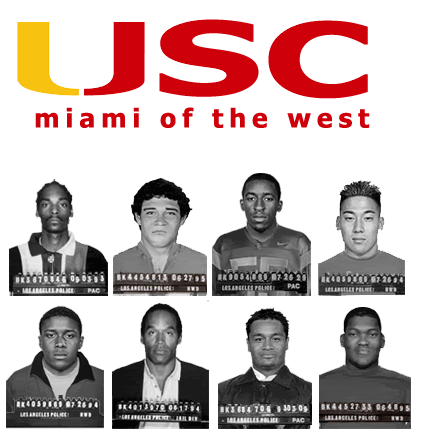
You know it is the off season when SC football players start showing up on police blotters. The AP reported that Trojan safety Josh Pinkard was arrested earlier this month on suspicion of driving under the influence.

"We're looking into it, and we'll find out the details," Carroll said. "As usual, we'll handle it internally. We take this seriously, and we want to make sure we understand all of the circumstances."

Whats funny about that statement is that Carroll and the SC coaches now have a "usual" way of handling trouble with the law. Of course the "internal" punishment probably means that player will have to run a few laps or maybe not start a game (well, at least until the player he is backing up goes down with an injury).

There are also internet rumors circulating that USC linebacker Kaluka Maiava was involved in an altercation out in Hawii. The details aren't clear, but some posters stated that it was fight between Kaluka and a woman. It has been reported by GaryP over at WeAreSC that a police report has been filed but no charges have been brought, yet. Maybe Kaluka has been hanging out with Frostee Rucker recently.

Some posters on BRO had this account of the incident:

"An arrest warrant has been issued for USC Linebacker Kulaka Maiava. Maiava, according to several witnesses, trespassed onto the campus of Baldwin High School in Wailuku Tuesday and began a heated discussion with a 17 year old female student. Maiava, according to witnesses then assaulted the student causing a blackened eye, broken nose and forcing her to be hospitalized over night with a concussion. Maiava then assaulted the student's boyfriend who tried to intervene. Both students are scheduled to graduate later this week."

Looks like old Pete is running a tight ship, like usual.

Jeremy McGee Transfers

Rumors have been swirling around Bruin websites and message boards for the last few weeks that Jeremy McGee might transfer out of UCLA. Yesterday, the transfer was made official when Ole Miss head coach Ed Orgeron announced that McGee had accepted a scholarship offer.

"We are excited to have Jeremy McGee joining our program," said Orgeron, "He is from Louisiana, a state where we have recruited well. We welcome Jeremy and his family to ours."

McGee, who was a true freshman last year, saw playing time on special teams. He was assigned kick return duties near the end of the season. Jeremy, who originally was recruited to Westwood as a running back, was switched to corner during the fall camp after Michael Norris was injured, and then to wide receiver.

Jeremy recently returned home to New Orleans be with his family after the death of his mother. This will give him an opportunity to be closer to his father while he completes his college career. He will enroll at Ole Miss this July after completing his classes at UCLA.

We wish him all the best!

Tuesday, May 29, 2007

Rivals 100

The rivals network released their top-100 players for 2008 today. A few Bruin commits made the list:

#43 Rahim Moore (S)
#90 EJ Woods (S)
#93 Kemonte Bateman (WR)

Moore and Woods are going to make a dynamic duo in the UCLA secondary for years to come. If Bateman gets his grades ironed out, he could also be a big impact player for the Bruins. A few other players that UCLA is actively recruiting also are in the top-100:

#11 Tyron Smith (OL)
#40 Blake Ayles (TE)

One of the recruiting experts on Rivals thinks that some other commits might find their way into the top-100 if they have big Senior seasons. Jeremy Crabtree had this to say about 3 other UCLA commits:

To me, Uona Kavienga might get overlooked a little bit because he doesn't play for one of the traditional powerhouses in Los Angeles. He also doesn't not have the physical measurements of some other linebackers in this year's class. I do know it's a very good crop of linebackers, so that makes it tough to compare him to some of the great ones like Nigel Bradham and Arthur Brown. Kavienga brings a tremendous amount of heart and desire to the table. There's a reason that a linebacker-rich school like Oklahoma hasn't given up recruiting him. The kid's a player, and he's one I think eventually will prove he's a top 100 player in the nation.

He also likes Datone Jones and Arron Hester. Some analysts think that that Hester and Anothony Dye are one the best corner combos in the west. When you add them to the mix with Woods and Moore, you can make a pretty good case that UCLA has one of the strongest groups of corners and safeties in the nation for 2008.

Monday, May 28, 2007

Arizona and ASU Statistics

I just uploaded new 2006 statistics for Arizona and Arizona State. I wasn't able to get data for all of their games and I think both teams are missing one or two. Anyways, still very interesting to see the information for the desert schools.

For Wildcat and Sun Devil fans coming to this blog for the first time, you may want to check out the statistics for USC and UCLA as well. Eventually all of UCLA's 2007 opponents, including the entire PAC-10, BYU, Utah, and Notre Dame will be available. You can always find the latest Bruin Roar Football Stats on the right-hand side of the blog.

Saturday, May 26, 2007

Drew Olson - Week 7

Before getting to this weeks game against the Cologne Centurions, the AP put together a nice little article about Drew's time in Amsterdam. Drew faces an uphill battle when he gets back to Baltimore this fall. He'll have to compete with Troy Smith, the Heisman trophy winner from Ohio State, who the Ravens picked up in this year's draft.

"I've been watching what Drew's been doing in Amsterdam," Ravens coach Brian Billick said. "We think the time in Europe is going to serve him very well, and hopefully when he comes back we'll have a chance to see how it translates into what we're doing here."

Former UCLA quarterback, and current Ravens QB coach and Offensive Coordinator, Rick Neuheisel had this to say about Drew. "It's not all pretty with Drew. He's kind of a throwback to Billy Kilmer. His ball doesn't always spiral and it isn't always going to be gorgeous. But he's a winner, which is why we encouraged him to go to Europe - to prove once again that's what he is."

The coaches say there will be a competition for the backup spot on the roster, but I have a hard time believing they would cut their recent draft pick in favor of a free-agent who just spent time in the "minor" leagues of NFL Europa. If Drew doesn't make it at Baltimore, he may be able to find a spot on another team. Smart accurate quarterbacks are always good to have around. Drew is keeping a positive outlook and his latest blog entry is pretty upbeat about the whole thing.

Anyways, back to this weeks game. The Admirals got absolutely crushed by Cologne, scoring their only points in the 4th quarter after the outcome was no longer in doubt. Cologne has one of the best defenses in NFL Europa and they completely stifled Olson's offense.

Drew connected on 16 of 38 passes for 196 yards and 1 touchdown. Not a good effort, but the majority of the blame fell at the feet of his offensive line. The Admirals frequently used this weird spread formation with large splits between the big guys up front. They couldn't hang with Cologne's athletic defensive front and Drew was constantly under pressure. They had negative yards in the first quarter and it didn't get much better from there. Drew didn't complete his first pass until almost 4 minutes left in the first quarter.

In the second quarter, Olson threw a lateral on a poorly-executed swing pass that ended up going over the running backs head and the ball was recovered by Centurion players deep in Amsterdam territory. He was fortunate that it only ended up in a field goal. Even when Drew was able to connect with his receivers, they would not get many yards or would turn the ball over on a fumble. He struggled with accuracy on longer routes and as Amsterdam fell further behind, the worse his attempts became. It was an all around ugly game.

It doesn't look like the Admirals are going to make the World Bowl game this year. So that means Drew only has three more weeks left in his season with Amsterdam. Next week he takes on the Rhein Fire.

Friday, May 25, 2007

On the Recruiting Trail

In the dog days of summer, between the Spring and Fall practices, the coaches hit the pavement to evaluate high school recruits from around the country. Lots of companies and organizations hold combines, which are like day camps, where the players are put through drills, evaluated, and measured seven different ways from Sunday. Dorrell and company have been visiting a number of these camps over the last few weeks and racking up some frequent flier miles in the process.

Scout reported that Coach Walker was at the Palo Alto Nike Camp to see some of the best talent in the West. That included uncommitted running back Covaughn Deboskie, who is a top target for the Bruins. Some UCLA commits also had a good showings at the the Nike camp, including linebacker Uona Kaveinga.

Dorrell and running backs coach Dino Babers were in Hawaii for the PIAA combine. UCLA has landed some great talent from the islands in recent years, including starting offensive guard Micah Kia and backup defensive end Dylan Rush. It would be great to get a pineapple pipeline of players coming into Westwood. We'll see if Dorrell extends any offers after he returns to the mainland. On a side note, I need to get a job where flying out to Hawaii for a week is considered "working".

With UCLA getting off to such a fast start with the 2008 class, the coaches can take their time and be selective in offering players scholarships. There are still no offensive lineman committed in that class, so I expect the coaches to target a few of the top prospects this summer. The Bruins will probably also take another running back or two and it looks like UCLA is in the running for Milton Knox and Deboskie.

Deboskie has received a lot of attention from Division-1 schools like Arizona, Cal, Florida, USC and, of course, UCLA. He has mentioned in an interview with Scout.com that early playing time is a key factor in his decision making process.

"I may not go into a situation where I start, but I would like to get some playing time as a freshman," said Deboskie. "I want to be able to get some exposure as a freshman and get adjusted early.

With Markey leaving after this season, the Bruins will have an opening at the tail back position and Deboskie definitely has the talent to compete for playing time from day one. He also wants to play for a team with unity and chemistry, which the current Bruin squad has in abundance.

"I am looking for a team with a lot of unity," said Covaughn. "I want a team that plays hard together because those teams win a lot of games. I don't want to be on a team that is built around one player. When everyone starts up with all of the talk about this guy is an impact player and things like that, people get jealous."

Covaughn has said that he is looking to commit early and may make a decision before the football season starts. We'll have to wait and see if he decides to be a Bruin. It would be awesome to have Deboskie, Dean, and Carter in the backfield for 2008.

(Photo: Karl Dorrell, UCLA; Mark Banker, Oregon State; Dino Babers, UCLA. Credit: PIAA)
(Photo credit: azcentral.com )

Thursday, May 24, 2007

Statistics Feedback from SC and UCLA fans

After visiting a couple Trojan and Bruin message boards this week, I received a lot of good feedback from football fans of both schools. Here were some of the suggested additions to the Bruin Roar Football Statistics data:
  • "Efficiency numbers" and "Red Zone efficiency" from localbruin on BruinGold.
  • "Play calling by distance and down together" from tommytrojan1122 on WeAreSC.
  • "Points Per Possession/Minute" from WestsideUSCFan on WeAreSC.
  • "1st-10th play, etc performance" from Anonymous on BruinRoar.
I've already added some of those to the latest version of the reports. I'm going to see if I can add the others in the next couple of months. I came up with a few more ideas myself:
  • Special teams break downs for punts, kick-off returns, field goals, etc.
  • Play calling sequences for first 3 plays in a drive.
  • Scoring plays by distance.
  • Turnover break down on fumbles and interceptions.
  • Breakdown of drive length by number of plays, distance, and time-of-possession.
If you are itching for a statistic, even an ad-hoc query for something you are interested in knowing, drop me a comment on the blog and I'll see if I can help you out.

Tuesday, May 22, 2007

Ranking the Rankings

It is exactly 101 days until the start of the 2007 football season. That might seem like a long ways off, but it is never too early to start talking about pre-season rankings. Or maybe we should call these the pre-pre-season rankings. In any case, lots of publications have come out with their list of top-25 teams for 2007.

You might ask, "Who cares about such rankings?". Well, you should care. Rankings in college football mean a whole lot, especially if you are trying to get to an elite bowl game.

Of the 25 teams that started last season ranked in the AP Poll, 8 of those teams made a BCS bowl. That's a 33% chance of making it into an elite bowl game. Only 1 team from a BCS conference, Wake Forest, played their way into a BCS game after starting the season outside of the top-25. There are 65 teams from BCS conferences, so that means unranked teams had a 1.5% chance of making it. It doesn't take a mathematician to know that your chances go way up when starting the season ranked!

Here is what the experts are saying. Some of these rankings were written before Ben was named the starting quarterback by Coach Dorrell.

Sports Illustrated: #22
With a staggering 20 returning starters from the squad that stunned USC in last year's regular-season finale, the biggest mystery this spring has involved the quarterback race between incumbents Pat Cowan and Ben Olson. Both have struggled against UCLA's loaded defense.
Fox Sports: #9
Who will the quarterback be? The Pat Cowan/Ben Olson debate will be the big one this off-season. That's the only offensive issue with 10 starters returning. The defense loses Justin Hickman, but All-America end Bruce Davis comes back, along with nine other starters. The team's biggest loss is PK Justin Medlock.
Athlon Sports: #15
The arrival of DeWayne Walker from the NFL coaching ranks as defensive coordinator was just what the doctor ordered, bringing vast improvement on that side of the ball, and the top eight tacklers all return. End Bruce Davis is one of the best pass rushers in America, having registered 12.5 sacks (tied for fourth nationally) last season, and there are four battle-hardened performers at the tackle positions, including starters Kevin Brown and Brigham Harwell.
Lindy's Sports Annual: #22
This is UCLA’s time. Nine of the defensive starters are seniors. Seven offensive starters are seniors. If the Bruins could be trusted to be more consistent, the ranking would be even higher.

Here are some other online publications ranking the Bruins:

SportingNews.com: #6
College Football News: #9
NationalChamps.net: #15
ESPN: #23
Rivals: Unranked

It looks like the Bruins will end up somewhere in the high-teens, low-twenties. That's not a bad starting spot. The relatively easy early schedule should allow the Bruins an opportunity to move close to the top-10 before starting the more difficult part of the schedule. I think the first big test will come September 29th when our boys head up to Corvallis to play the Beavers.

Monday, May 21, 2007

Williams ends Football Career

Jill Painter is reporting on Dohn's blog that running back Derrick Williams is ending his career as a UCLA football player. Williams has had a lot of concussions over the last two years and this wasn't entirely unexpected. He suffered his latest injury during a spring practice and had a number doctors examine him. I think this is the right decision because you don't want to mess around with concussions. The more you have them the more likely you are to get them in the future and cause permanent damage.

This opens up the running back rotation and I think incoming freshman Raymond Carter will definitely see some more minutes this fall. Williams was the fastest back on the roster last season and Carter, who runs track at Crenshaw, will now be the only speedster in the bunch.